
Metro Manila is often described with one word: crowded.
But for advertisers, that crowding isn’t a weakness — it’s a media advantage.
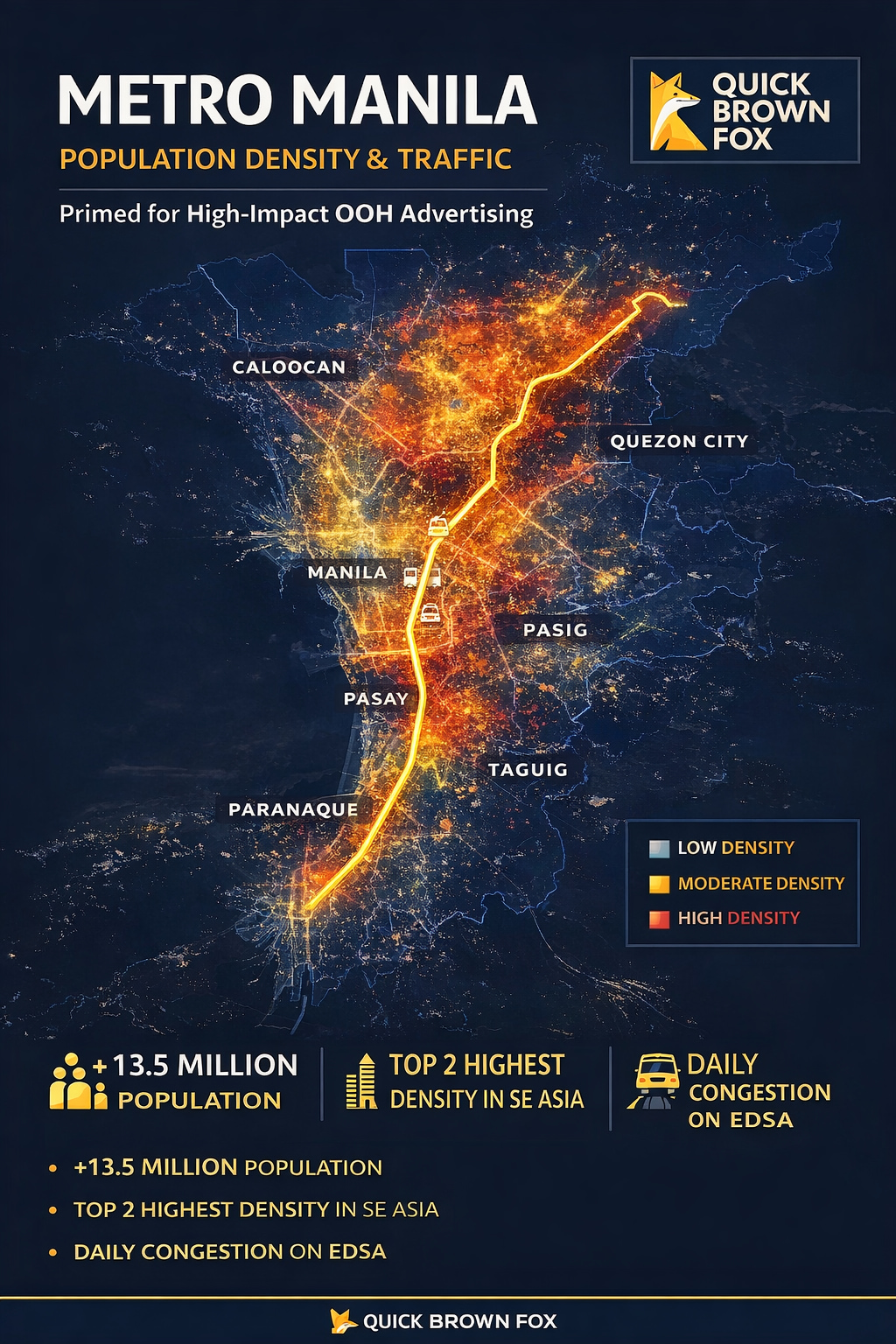
With one of the highest urban population densities in Southeast Asia, Metro Manila concentrates people, movement, and attention into a compact footprint. In an era of fragmented digital attention, Out-of-Home (OOH) advertising performs best in environments exactly like this — especially along EDSA, the country’s most important transport corridor.
Below are 10 reasons why population density in Metro Manila amplifies — not hurts — OOH advertising effectiveness.
1. Density Creates Guaranteed Reach
In dense cities like Metro Manila, exposure is unavoidable. People travel the same roads, pass the same intersections, and encounter the same billboards every day. OOH does not rely on algorithms or user intent — reach is built into daily movement.
2. Long Commute Times Increase Frequency and Recall
Traffic congestion increases dwell time. More time in traffic means more opportunities for brand messages to register. In Metro Manila, traffic multiplies exposure and strengthens recall.
3. EDSA Functions Like a Daily Broadcast Channel
EDSA cuts across multiple cities, income segments, and routines. This makes EDSA billboards comparable to a physical broadcast channel, delivering massive and consistent reach every day.
4. Density Reduces Media Waste
High population density means audiences are concentrated rather than dispersed. OOH placements benefit from lower audience dilution, resulting in stronger cost efficiency per exposure.
5. Repetition Builds Brand Familiarity Faster
Repeated exposure builds trust. Brands seen consistently along daily routes feel established and credible, accelerating familiarity and recall.
6. Density Amplifies Digital Campaigns
OOH often triggers online behavior such as brand search, website visits, and social engagement. Metro Manila’s dense, mobile-first population accelerates this effect.
7. Transport Hubs Multiply Exposure
MRT stations, bus terminals, and interchanges compress large volumes of people into small areas. OOH near these hubs benefits from layered exposure across multiple audience types.
8. Dense Cities Create Shared Visual Memory
In dense cities, billboards become reference points. They enter everyday conversation and embed brands into the city’s shared visual culture.
9. Clutter Rewards Scale and Consistency
Crowded environments reward brands that commit to visibility. OOH works because it meets density with scale, clarity, and consistency.
10. Density Turns Visibility Into a Strategic Advantage
Population density is structural, not temporary. Brands that secure premium OOH placements early benefit from long-term visibility in a market where attention is guaranteed. Metro Manila may be crowded — but for brands, that crowd is exactly what creates opportunity.
Density does not weaken OOH advertising. It powers it.
Too crowded to ignore. Too dense to overlook.

Franco Alvarez is the Founder and CEO of Quick Brown Fox, an independent media group specializing in Out-of-Home (OOH) and Experiential Media strategy and implementation. With a career rooted in world-renowned media conglomerate GroupM (WPP), Franco brings a deep understanding of client needs and high-level media strategy.
At Quick Brown Fox, Franco leads client acquisition and management, business development, strategic partnerships, and revenue generation. He has worked with top-tier clients including HSBC Philippines, AIA Philippines, Pepsi Philippines, Omnicom Media Group Philippines, Sunnies Inc., and Netflix, as well as international accounts across Singapore, Indonesia, Hong Kong, and Malaysia.
Franco’s expertise spans the full spectrum of media planning and execution, giving him a unique perspective on delivering measurable results for both local and global brands. His leadership philosophy focuses on building long-term client relationships, fostering strategic partnerships, and creating innovative campaigns that maximize audience engagement.
Passionate about driving the growth of independent media in the Philippines, Franco continues to shape Quick Brown Fox into a trusted partner for advertisers seeking cutting-edge OOH and experiential media solutions.
Connect with Franco Alvarez on LinkedIn