
“How many people actually saw my billboard?”
It is probably the most common question advertisers ask about Out-of-Home advertising.
And it is a fair question.
But at QBF, we think it is also the wrong question to start with.
Not because OOH cannot be measured.
It can.
But because OOH does not work like digital advertising, and it should not be measured as though it does.
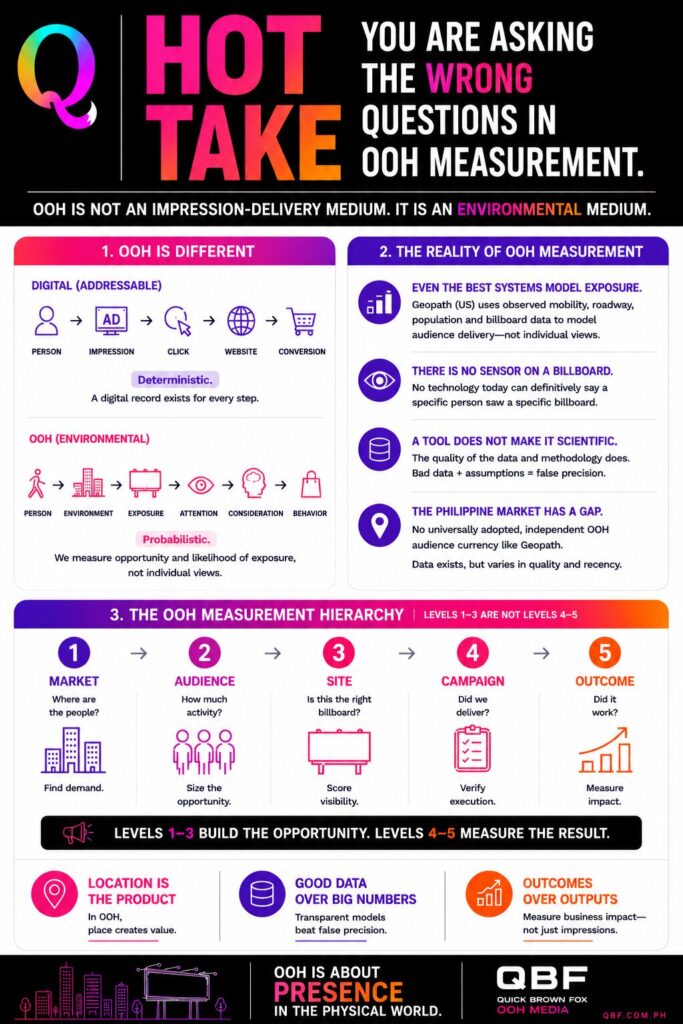
OOH IS NOT AN IMPRESSION-DELIVERY MEDIUM.
IT IS AN ENVIRONMENTAL MEDIUM.
DIGITAL AND OOH WORK DIFFERENTLY
Digital advertising is fundamentally addressable.
The chain is relatively straightforward:
PERSON → IMPRESSION → CLICK → WEBSITE → CONVERSION
A digital platform can record interactions at each stage.
OOH works differently.
A person moves through a physical environment. A billboard occupies that environment. The person may notice it, glance at it, remember it, see it repeatedly, or simply absorb the brand’s presence without consciously engaging with it.
The chain is closer to:
PERSON → ENVIRONMENT → EXPOSURE → ATTENTION → CONSIDERATION → BEHAVIOR
There is no click.
There is no login.
And there is no sensor on a static billboard that can definitively tell us:
“Person #8472 looked at this billboard for 2.7 seconds.”
That is why OOH measurement is fundamentally probabilistic rather than deterministic.
PROBABILISTIC DOESN’T MEAN UNMEASURABLE
This is where the conversation gets interesting.
The world’s most sophisticated OOH measurement systems don’t literally count individual pairs of eyes looking at every billboard.
Take Geopath in the United States.
Geopath combines observed mobility data, roadway information, population information and detailed billboard characteristics to model audience delivery. Its methodology considers factors such as location, direction, visibility, traffic speed and dwell time.
In simple terms:
OBSERVED MOVEMENT → MODELLING → ESTIMATED EXPOSURE
That is sophisticated measurement.
But it is still measurement by probability, not a sensor counting individual views.
Even Geopath defines audience delivery in terms of people who are likely to notice an OOH display.
And that distinction matters.
A TOOL DOESN’T MAKE A MEASUREMENT SCIENTIFIC
Imagine a dashboard tells you:
Billboard A — 487,329 impressions
Billboard B — 421,782 impressions
It looks incredibly precise.
But precision and accuracy are not the same thing.
Where did the numbers come from?
Is the traffic data current?
Was the billboard’s visibility considered?
What assumptions were made about vehicle occupancy?
What about traffic speed and dwell time?
Was the data independently validated?
If the underlying data is weak and the assumptions are arbitrary, a sophisticated dashboard simply creates false precision.
A tool does not make a measurement scientific. The quality of the underlying data and methodology does.
This is particularly relevant in the Philippines, where there is currently no universally adopted, independent OOH audience currency equivalent to Geopath. Audience estimates may draw from traffic counts, operator data, agency research and increasingly mobile/GPS-based approaches, but methodologies and data quality can vary.
That doesn’t mean Philippine OOH cannot be measured.
It means we should be honest about what we know, what we estimate and what we cannot directly observe.
SO HOW SHOULD OOH BE MEASURED?
At QBF, we think about OOH measurement as a five-level hierarchy.
01 — MARKET
Where are the people?
Major roads. CBDs. Commercial centres. Residential concentrations. Transportation corridors.
02 — AUDIENCE
How much human activity exists here?
Vehicular traffic. Pedestrians. Population density. Commuter movement. Destination density.
03 — SITE
How good is this particular billboard?
Visibility. Approach angle. Traffic speed. Dwell time. Obstruction. Distance. Elevation. Road geometry.
04 — CAMPAIGN
Did the campaign actually run correctly?
Correct location. Correct creative. Correct dates. Correct SOV. Correct rotation. Proof of posting or play.
05 — OUTCOME
Did OOH contribute to the client’s objectives?
Brand awareness. Search activity. Store visits. Sales. Conversion lift. Incremental revenue. Brand lift.
And here’s the critical distinction:
LEVELS 1–3 ARE NOT LEVELS 4–5.
A traffic count does not prove a sale.
A reach estimate does not prove a conversion.
A visibility score does not prove a purchase.
And a post-campaign increase in sales does not automatically prove that every additional sale came from the billboard.
Each level answers a different question.
LOCATION IS PART OF THE MEDIA PRODUCT
This is perhaps the most important difference between OOH and other media.
In digital, the environment surrounding the advertisement is largely separate from the advertising product.
In OOH, the environment is the product.
The road matters.
The traffic matters.
The speed matters.
The surrounding buildings matter.
The angle matters.
The visibility matters.
The repetition matters.
That is why two billboards on the same road can have completely different media value.
And why a billboard in a high-volume, high-visibility corridor can be powerful without requiring an artificial algorithm to first tell us that the location is valuable.
You don’t need AI to understand why Times Square is valuable OOH real estate.
Likewise, you don’t need a sophisticated model to understand why major Philippine corridors and CBDs create powerful OOH environments.
The model can make the estimate more precise.
It does not create the value.
DIFFERENT MEDIA. DIFFERENT MEASUREMENT.
Digital measures interaction.
Search measures intent.
Social measures engagement.
TV measures audience consumption.
OOH measures presence in the physical world.
That doesn’t make OOH less measurable.
It makes it different.
OOH reaches people while they are commuting, walking, working, shopping and travelling.
And unlike an ad that disappears when the screen changes, OOH becomes part of the environment people repeatedly move through.
That physical presence is the product.
THE QBF APPROACH
We don’t believe OOH should be unmeasured.
We believe it should be properly measured.
Our principles are simple:
MEASURE what can be measured.
MODEL what can be modelled.
DISCLOSE what is assumed.
VERIFY what was actually delivered.
MEASURE OUTCOMES when appropriate data exists.
And most importantly:
NEVER PRESENT AN ESTIMATE AS AN OBSERVED FACT.
SO, WHAT IS THE RIGHT QUESTION?
Instead of asking:
“How many people actually saw my billboard?”
we believe advertisers should be asking:
“What was the opportunity for exposure, how strong was that opportunity, did we deliver it properly, and what evidence do we have that it contributed to the desired outcome?”
That is a much more useful question.
And it reflects the reality of the medium.
Because OOH doesn’t exist in a browser.
It doesn’t exist inside an app.
It doesn’t exist behind a login.
OOH EXISTS IN THE PHYSICAL WORLD.
And that’s exactly what makes it different.
LOCATION IS NOT MERELY A DISTRIBUTION MECHANISM.
LOCATION IS PART OF THE MEDIA PRODUCT.
That’s how we think OOH should be measured.

Franco Alvarez is the Founder and CEO of Quick Brown Fox, an independent media group specializing in Out-of-Home (OOH) and Experiential Media strategy and implementation. With a career rooted in world-renowned media conglomerate GroupM (WPP), Franco brings a deep understanding of client needs and high-level media strategy.
At Quick Brown Fox, Franco leads client acquisition and management, business development, strategic partnerships, and revenue generation. He has worked with top-tier clients including HSBC Philippines, AIA Philippines, Pepsi Philippines, Omnicom Media Group Philippines, Sunnies Inc., and Netflix, as well as international accounts across Singapore, Indonesia, Hong Kong, and Malaysia.
Franco’s expertise spans the full spectrum of media planning and execution, giving him a unique perspective on delivering measurable results for both local and global brands. His leadership philosophy focuses on building long-term client relationships, fostering strategic partnerships, and creating innovative campaigns that maximize audience engagement.
Passionate about driving the growth of independent media in the Philippines, Franco continues to shape Quick Brown Fox into a trusted partner for advertisers seeking cutting-edge OOH and experiential media solutions.
Connect with Franco Alvarez on LinkedIn